REVIEW: “Gravity” (Def Dee & Language Arts)

No idea’s original/There’s nothin’ new under the sun/It’s never what you do/But how it’s done.” — Nas

This fairly dubious assessment on the state of hip-hop progression was proffered by Nas in his song, “No Idea’s Original.” The statement, however, is generally recognized as a universal truth among musicians of any type of music — and artists of any medium, really. Everything in a genre’s canon, even up to its most current iteration, is built upon something from its past. In an odd contradictory sense, modern practitioners depend upon clinging to their art’s long-buried roots in order to move their agenda forward. There would be no progression without that fond nostalgic echo.

And nostalgia is something not in short supply when it comes to memories of hip-hop as it existed in the early to mid 90’s. The Golden Era, as it’s lovingly called, is when hip-hop came of age. And fans of the music who were old enough to appreciate that evolution as it occurred cling to the artists of that time period the same way a hungry rapper clings to a mic; for them, it’s an impossible separation. The sounds and styles of that time provide a point-of-reference for those fans’ identities as lovers of the music and influence their critiques of hip-hop as it exists today; perhaps even sometimes to the detriment of a contemporary artist’s deserved appreciation. (Philosophical debates — even well-written ones — have been posited on this very subject.)

The fact that local duo Def Dee and Language Arts (LA for short) have created Gravity in 2010, an album that clearly owes its existence to the Golden Era (especially as manifested in New York City), is not something to be taken lightly. Hip-hop music was certainly being made in Seattle in the mid-90’s but, save for the antics of Sir-Mix-a-Lot, the scene was confined strictly to the underground. The closest thing Seattle had to NYC Golden Era hip-hop was Tribal’s seminal 1996 compilation, Do The Math, a formative and well-known album for local emcees now in their late 20’s to early 30’s, but not a particularly familiar one to the average fan of the same age. New York’s influential boom-bap of the time was loud enough to ring from coast to coast and Do The Math is evidence of that reverberation in Seattle. That the majority of the city’s impressionable youth were too busy shopping for plaid and flannel, however, is not Tribal’s fault.

The local hip-hop scene as it exists today is interesting. The Golden Era was hip-hop’s officially recognized renaissance, but Seattle seems to currently be experiencing its own unique version. The mid-90’s hip-hop genome has already been mapped and well-documented, but perhaps never fully evolved locally until now. Gravity shares the same musical genes as Pete Rock, Jay Dilla and Mobb Deep of the Golden Era. Listening to the album’s sixteen tracks is like following a trail of Timberland boot-prints through that time period. All of the usual production suspects are present: scarce melodies; tightly-wound kicks and snares; the satisfying discord of crackle, pop and hiss behind the samples; chopped-up keyboard licks; and, perhaps most fundamental of all, bass acting as percussion which creates the thick atmosphere that holds everything together. What’s most remarkable here is how producer Def Dee’s mid-90’s aesthetic doesn’t imitate, but actually builds upon what came before. Def doesn’t mimic or parrot his sources of inspiration, he deftly crafts the beats with just as much skill as his predecessors. His work on Gravity is an astonishing accomplishment in that regard.

While Def’s beats lay the pavement for the ride, the man primarily responsible for driving is emcee Language Arts. He weaves his street-oriented rhymes so effortlessly through the tracks that it takes a few listens to realize just how versatile and effective his presence is. Simply put, LA can rhyme his way around any emcee in the 2-0-6. On “Uno Amore” he declares, “Reinvent the wheel? No I’m patchin’ up the tire,” which is an accurate self-assessment considering LA pulls as much from Nas’ Illmatic-era cadence as he does a characteristically West Coast nonchalance. LA uses his flow to tie Def’s beats up into tidy knots, seemingly never needing to breathe on “To Sir With Love,” which features a boot-stomping rhythm that he matches vocally march for march. Though LA is the primary voice in this group, Def’s tracks ride shotgun alongside his partner, saying as much through rhythm as could possibly be said without words. They’re a consistent and impressive two-man show on tracks like “Day In The Life,” with LA displaying a dexterous rhyme handle over Def’s self-inflicted staccato piano stabs. Every track on Gravity features a quality of rapping that equally matches the quality of its accompaniment.

To say that Gravity is the closest thing Seattle has to its own Illmatic is potentially dangerous hyperbole that immediately turns the author of this review into a target for criticism and attempts at discrediting his hip-hop knowledge. But who cares? Given that hip-hop’s fundamentalism is built (at least partially) on series of robust embellishments, the statement can and should be made given the nature of the two albums. Gravity could also be a cousin, once or twice removed, from Mobb Deep’s Hell On Earth, though it’s not nearly as cold. While it is decidedly “street,” Gravity‘s disposition doesn’t begin to approach Havoc and Prodigy’s flagrant nihilism (for example: nowhere do Def or LA make reference to being stabbed by an ice-pick).

As Nas asserted: “No Idea’s Original.” And to capably make an album like this with such conspicuous ties to the forebears previously mentioned, Def Dee and LA must understand that idiom. The significance of what they’ve created, and when they created it, means even more when considered in the context of Seattle’s hip-hop history. The Six never spotlighted this version of hip-hop. And, while it’s nothing new under the sun, it’s never what you do, but how it’s done. The virtue of Gravity is that it’s done right.

(Def Dee and LA’s Gravity is available for FREE download at the group’s Bandcamp page, here.)
Album Reviews Downloads

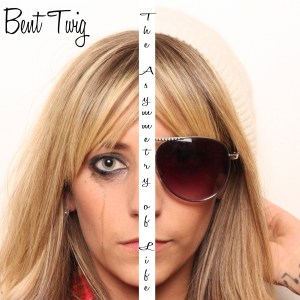
REVIEW: “The Asymmetry of Life” (Bent Twig)

(The Asymmetry of Life is available for FREE download. Click here or above for the link.)

The Six’s first great summer riding soundtrack dropped last Friday with hardly a peep or tweet heard in local hip-hop’s otherwise boisterous online stomping ground. Cali-natives Soos and Preach, known together as Bent Twig, released a surprisingly capable and confident full-length debut album called The Asymmetry of Life that has thus far gone virtually undetected by the local blogs (save for yours truly and its compatriots at Seattle Show Gal). The conspicuous presence of Town players Ill Pill, Scenik, Grynch, Sol, and Geologic on the album, adds a further (and surprising) validity to this under-the-radar release.

The Asymmetry is a fifteen-track collection of laid-back, breezy, hip-hop, with funk/disco/pop sensibilities. Bent Twig (whose members grew up together on a street of the same name in Camarillo, CA) value the positive mental attitude derived from such feel-good music, which is a perfect accompaniment to backyard barbecues and cook-outs at Alki Beach. As the weather begins to transition, their debut album is just in time for such events.

Bent Twig’s rhyme topics are lighthearted and relatively narrow in scope. The party life is celebrated in an inoffensive way (“Good Music”); pursuing love and shorties is described with a PG-13 rating (“Cinderella Girl”); and motivational pep talks and commemoration of loved ones are included, too (“Can’t Go On” and “Like You”). Preach and Soos deliver their lyrics via casual conversational flow or in half-sung emcee stylings. It may all sound like cotton candy rap and, for the most part, it is. But Preach and Soos are so unrelenting in their positivity, all their good-guy talk comes across as genuine and endearing, not annoying or preachy.

Sonically, everything here is danceable and easy to listen to. Disco and funk inflections are prevalent throughout, but unlike many recent local releases with similar influences, futuristic bleeps and blips and other musical nods toward the extra-terrestrial are noticeably absent. It’s a welcome respite. Bent Twig has found a comfort within its style, fully knowing what its sound is and embracing it with satisfying results.

Currently, Preach and Soos are both attending college (the former at the University of Washington, the latter at Arizona State) which makes it all the more impressive they’ve found time to produce and release an album of such quality. On May 27, the official album release party will pop off at High Dive. The noise around Bent Twig might be relatively quiet now, but more folks are likely to get hip to this duo as word gets out, and deservedly so — they’re a worthy new addition to the Town movement.

Album Reviews Downloads

REVIEW: “Code Red EP” (J. Pinder)

The Code Red EP is available for FREE download. Click here or the album covers below for the link.

The Code Red EP should probably be considered J. Pinder’s first official entry into the local rap game. The previously released Backpack Wax Mixtape served to introduce folks to the South End rhymer, and it was an unarguably excellent collection of scatter-shot beats and bars. Ultimately, however, it was exactly what it says it was: a mixtape; and thus lacked a coherence that effectively established J. Pinder’s particular identity. The Code Red EP achieves this with a self-assured nonchalance perfectly befitting this emcee.

The first thing you’ll notice is the production and guest shot lineups. Code Red is full of heavy-hitters like Jake One, Vitamin D, and Kuddie Fresh on beats, and established rappers Big Pooh and Guilty Simpson on feature bars. Because of the serious industry weight behind this brief eight-track collection, it sparkles with a certain professionally-applied sheen that we haven’t seen the likes of on any 2010 local releases.

This isn’t to say Code Red is all style and no substance. Quite the contrary. J. Pinder’s subject matter is categorically street-oriented, but ultimately trends toward that most complex of emotions dealt with by people from all walks of life: l-o-v-e. This album is really all about love. Love for your community, love for hip-hop music, love of self, love for your chick, love for your family, etc. There’s even a song about how dangerous and frightening it is to say, “I love you” (“Three Words”). A lack of love is generally the fundamental cause of society’s woes and J. Pinder understands that condition. Code Red is remarkable because the message is delivered in a grown-ass way, never preachy or holier-than-thou, just through observation and down-to-earth real talk.

If there is one knock on J. Pinder, it might be his rhyme style. While he has a knack for never wasting a word, the dude is so unassuming in his flow that he veers dangerously close to sounding indifferent. Not surprisingly, the best tracks on the album are those where he increases emotional effusion. “No Turnin Back” is a track so heavy and thick, it sounds like Vitamin D built it with bricks, concrete and asphalt. It’s about the dangers of losing positive focus when surrounded by so much negativity and J. Pinder gives a great vocal performance. A couple listens are required to appreciate how subtly he shifts from his normal casual breeziness to sounding downright icy. That he’s capable of carrying a track with so much audible weight is a great sign for his future.

Free EP’s are often crafted with the intention of building momentum for a full-length album. Occasionally they also succeed in standing alone on their own merits, as fully-realized collections of songs representing a concept or a brief statement of the artist’s general philosophy. Code Red is similar to The Physics’ 2009 High Society, two extended players that achieved multiple artistic objectives with relative ease. J. Pinder has deftly built an album good enough to capture listeners’ ears today and convincing enough that he’s worthy of following tomorrow.

Album Reviews Downloads

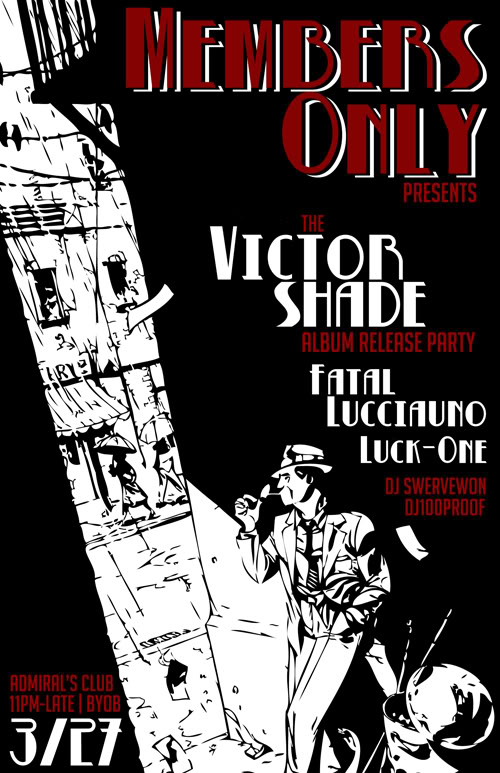
REVIEW: “Victor Shade” (Victor Shade)

In the Fall of last year, emcee RA Scion adopted the new rap persona Victor Shade, named after a character from Marvel Comics’ The Avengers series. The reasons for the change seemed to be two-fold: 1) an intentional distancing from his well-established identity as the emcee half of Common Market, a group (unfortunately) on indefinite hiatus; and 2) a tribute to his late brother-in-law, a comic book aficionado who personally bestowed the Victor Shade identity upon RA. Hip-hop fans around Town already know the man, born Ryan Abeo, as a dramatic stage presence whose shows have veered into performance art territory. So it’s unsurprising that his new Victor Shade project would be accompanied by a dramatic and well-documented change in his rap alter-ego.

It’s a change that serves to blatantly announce his re-entry to the rap game sans his previous collaborator, DJ/producer Sabzi, a notable proposition not just because of how well-entrenched Common Market is in the local rap psyche, but because the two artists seemed like natural extensions of each other, a rare duality that many don’t find throughout an entire career. Well, in case you’re wondering, Common Market fans, there’s no need to fear as this new iteration, while certainly different sonically, is not an uncomfortable deviation from what you’re used to.

Common Market’s last major release, 2008’s Tobacco Road, was a sprawling exercise in conceptual hip-hop. It featured a few classic moments but ultimately was too long, its length consistent with what one would expect from RA Scion, a rapper with so much on his mind that his lyrics literally required hip-hop Cliff’s Notes (which he occasionally provided on his blog). CM’s self-titled debut, on the other hand, was of more manageable length and should now be considered a local rap classic. Like Blue Scholars’ first album, it perfectly replicated the mind-state of Seattle’s liberal populace: current but old-school; urban but organic; aggressive with its principles but…neighborly. Victor Shade finds a comfortable middle ground between the two CM albums. And, while the rapper in question might balk at any extensive comparison, the exposition is necessary because RA Scion, as he existed in Common Market, is our only point of reference.

A new producer means a new sound. Everett beat-maker MTK is responsible for all twelve tracks on Victor Shade. His style is notably more aggressive than Sabzi’s, which isn’t to say the CM composer didn’t bring out the natural battle-rhymer in RA. (As previously noted, theirs was a relationship based on mutual ability, essentially meeting each other halfway in their artistry.) If anything, RA seemed to bring out the battle-producer in Sabzi. MTK, on the other hand, brings a grenade to a knife fight, meeting Victor Shade at the gravel pit where he’s already most comfortable. With monitors drenched in gasoline and a lit match in hand, their fusion on wax is generally incendiary. For lack of a more elegant editorial: the sh*t totally f*cking knocks. MTK’s assailing production is a perfect vehicle for the natural go-hard tendencies of the rapper.

Yet, with a flow so conducive to battle-rhyming, it’s still impossible to overlook Victor Shade as a pure poet. The density of rhyme and structure is simultaneously his greatest strength and overarching flaw. Similar to Talib Kweli, it’s often hard to follow, understand, and digest what he’s saying. That seems like a petty and nearly useless criticism when considering most rappers don’t say sh*t, but it is what it is.

In Common Market, RA Scion was a poet for the proletarian class and Victor Shade keeps the same company here. Although this time he fancies himself as a bit of a hero for those folks, walking amongst them but not altogether of them. Subversive critiques of our social conditions are the rule of the day (“Bodega Politics”, “Boots”, and “Soothsayer”, for example). Victor Shade requires that you hear more than listen in order to get the picture. For some reason, that exercise is a challenge contemporary hip-hop heads struggle with, probably because we’re too busy breaking our necks to the beat when we should be taking notes (a symptom of the relatively new producer-as-celebrity corollary). The value in Victor Shade’s treatise can only be found in taking the time to listen. And, like RA Scion before him, he’ll probably only respect us if we accept the provocation.

The greatest compliment one might pay to Victor Shade/RA Scion, is that listening to his music is a totally holistic experience. The emotive effects from his well-suited production choices, combined with his aptitude for meaningful lyricism (often existing on some higher esoteric plane), create a multi-layered experience uncommon in most rap music. It’s easy to draw a straight line between Victor Shade and artists in the hip-hop family tree to whom he’s directly related. Those folks include the likes of KRS-One, Chuck D, and Dead Prez. And, similar to those rap brethren, listening to Victor Shade casually is like trying to read really good literature on a noisy metro bus: you can get a sense of what’s happening, but you can’t fully appreciate it until you take the time to deconstruct it. Like Common Market before him, Victor Shade demands his listeners be active. Passivity, ultimately, is for suckas when it comes to this brand of intellectual hip-hop.

Album Reviews

REVIEW: Saturday Mourning (Gran Rapids)

Emcee Leach and emcee/producer Jay Battle are the duo who comprise Gran Rapids, a group whose debut album, Saturday Mourning, is a lengthy, party-rocking affair with a sound that trends toward the electronic end of the hip-hop spectrum. It’s startlingly confident and self-assured which, in the increasingly over-saturated local hip-hop market, is a necessity for a new group who wants to get noticed and have any hope of emerging unscathed from a crowded scene that’s a little like a downtown Metro bus during rush hour.

A national hip-hop critic wrote recently that, when in doubt, rappers wanting to expand their reach beyond backpackers and their over-sized headphones should just make a dance record; ie. a disco album with rap. Gran Rapids doesn’t paint itself into that small of a corner, but it rolls with the general idea. Party rap will get you noticed (especially around Town these days, with shows popping off every weekend), and that’s the direction GP takes Saturday Mourning.

There’s a lot of sh*t-talk set to uptempo beats, perfect for jumping up and down at the club in rapid succession (“The Good, The Bad, The Ugly”, “Rewsta” and “Wheredayat, Theredaygo!”, among others). Sometimes too much hip-hop with such subject matter makes the listener feel like he’s getting bludgeoned over the head with a broken MPC. That’s not the case with Gran Rapids. They bring just enough creativity to the table to make it enjoyable. Still, the album’s sprawling length dilutes the overall quality just a bit.

Leach and Jay Battle show the most promise for a sustained career in hip-hop on two tracks. “Make Us” is a determined head-nodder where both rappers display legitimate mic control skills and an understanding of the hip-hop fundamentals. And “Robot Fans” is an entertaining lampoon of those How Can I Be Down-type fans who want a piece of the music celebrity action (no matter how big or small). It’s still unclear whether Gran Rapids is fit or hungry enough to make it out of Seattle’s hip-hop kitchen as celebrities of the bigger variety. With the pot bubbling over, and every rapper jostling for position at the top, it’s hard to predict what will happen. Saturday Mourning, though, is a good enough indicator of a group worthy of keeping your eyes on.

Album Reviews

REVIEW: The Stimulus Package (Freeway & Jake One)

(Note: This review also appears on the national online hip-hop site Above Ground Magazine.)

For better or worse, Freeway possess one of the most recognizable and unique voices in hip-hop. As a result, he’s a bit of an acquired taste. Jake One the producer, on the other hand, is a 21st century version of DJ Premier. He uses appropriately melodic soul samples, dusty beats, and well-placed scratches to create a reliable and familiar dose of straight-forward hip-hop.

So while it’s possible the listener might have a more rewarding experience if Jake’s beats were blessed by a more, how-would-you-say, “accessible” emcee than Philly Freezer, it doesn’t change the fact that with their combined powers the two have crafted the best hip-hop album of 2010, thus far.

On one hand, it’s not out of bounds to say Freeway is generally under-appreciated as a rapper. On the other, you can say he’s gotten his just due. Point of reference is important here, too. From a philosophical standpoint, he’s one of those dudes that sort-of bridges the gap between backpackers and radio. Generally known and respected by true heads, Freeway is still only peripherally known by Clear Channel-ers, which is fine. Being a made hip-hop man (of which he is one), does not depend on your ability to please fans of both Brother Ali and Gucci Mane.

It does, however, depend on being reliable and consistent and Freeway has played his hand in the hip-hop game well. Decidedly street, his ability to be both an ambivalent and empathetic witness to the ethical dilemmas faced by fellow hustlers is one of his greatest strengths. On “The Product”, he paints a bleak picture of the role narcotics play in many aspects of American life, neither celebrating the drug lifestyle nor outright dismissing it as something altogether heinous. After all, if it’s a means to put food on the table when all else has failed, what can you ultimately say? Freeway admittedly keeps “One Foot In” the rap game and one foot in the street. This delicate balancing act allows him to maintain a level of authenticity that other rappers have lost.

Jake One, the other half of The Stimulus Package, has become a figurehead in Seattle hip-hop. He probably has the most national influence of any member of the local rap community but his voice is never actually heard. Jake speaks clearly and authoritatively through his beats. He’s an expert at taking a delicate soul sample and layering it over a well-crafted drum pattern such that the essence of the original music partially dissolves and reforms into something entirely new and exciting. His production is rarely flashy or ground-breaking — it’s just solid and consistent.

Jake is in high industry demand these days, and one of the reasons might be because his sound doesn’t seem to belong to any particular coast or region. You can hear obvious Dr. Dre-style Cali influences in the flourishes on tracks like “The Product” and “One Thing”, yet he also shows he can do Dirty South capably too on “Follow My Moves” and “Sho’ Nuff”. Jake One is a true student of hip-hop production; any rapper would be lucky to have him bless an entire album with his beats.

It’s refreshing to see a prominent hip-hop release with the ability to pay equal tribute to rapper and producer as Rhymesayers has done with The Stimulus Package. One DJ and one emcee was once the established symbiosis in hip-hop, but that has gone by the wayside for the most part. The schizophrenia caused by multiple rapper-producer collaborations has much to do with the inconsistent level of quality that plagues most albums. If more well-known rappers like Freeway would stick to the one DJ/one emcee ethic (the way our humble Town so frequently does), we’d see more LPs match the level of quality of The Stimulus Package.

Album Reviews

REVIEW: They LA Soul (Mash Hall)

The truth is, I’m an eighties baby who is a sucker for any nostalgia-inducing music that reminds me of my formative adolescent years. So when a group like They Live! Mash Hall enters the scene, late eighties to mid-nineties pop culture references flying, I’m immediately taken. Show me a group that can borrow snippets from Jodeci’s Diary of a Mad Band (mind you, not even that r&b group’s career-defining record), cultivate the awesomeness and unintentional comedy of the foursome’s bad-boy loverman antics into hip-hop party music gold, and then sign me up.

They Live!’s Mash Hall’s full-length debut, They LA Soul (released for free download on 12.24.09 via the band’s blog) works that party magic. It’s a collage of many things eighties-nineties: Die Hard, Stevie Wonder, Total Recall, Shai, and New Edition are all given stage time via brief audio samples, the visual equivalent of which would be rapid flashes of ADHD-inducing klieg lights. The whole organized mess is then spray-painted with basic hip-hop treatment in the form of 808 kick drums, high hats and hand claps. And it’s all narrated with an intelligent stoner’s hazy wit by emcees Bruce Illest (who sometimes sounds a little like 50 Cent — if 50 were white, way more stoned, and significantly less menacing) and Gatsby, whose assertive West Coast style exists somewhere between the unapologetic party-rocking antics of Sir-Mix-A-Lot and the confident street sensibilities of Ice Cube. They’re a bit of an odd couple, but that’s why it works.

The production here isn’t completely based on sample mash-ups, but it comes close. Most tracks are built around familiar blasts of audio that are immediately recognizable to anyone who remembers awkwardly dancing in middle school to songs like Shai’s “If I Ever Fall in Love” (heavily featured on “Serve You”), The Brotherhood Creed’s “Helluva” (here reimagined as an ode to West Coast diction, “Hella Hella”), and New Edition’s “If it Isn’t Love” (on “Can You Stand the Reign”, where They Live! Mash Hall uses a familiar section of the source material’s synthesized drum pattern to similar, and thus ironic, rhythmic effect). The best track is “Up Early In Em”, a bare-bones drum and bass posse cut (featuring Tay Sean, Spaceman and Ronnie Voice) about being on your daily grind.

They LA Soul is a charming, catchy proposition because it reminds us that the very first hip-hop dance parties originated as massive collaborative endeavors, the music invented basically on the fly by turntablists who practiced a pure and free-wheeling extraneous form of musicianship. Or, maybe that’s digging a little deeper than the members of They Live! Mash Hall intended. Could be, Bruce Illest and Gatsby just want us to drink a little, smoke a little, find some shorties who remind us of the Fly Girls, and wild the f*ck out. Yeah, pretty sure that’s what this record is all about.

Album Reviews Downloads

206UP.COM’s Top 10 Seattle Hip-Hop Albums of 2009

Contrary to what some prominent journalists and bloggers would have you believe, hip-hop in 2009 is not dead. At least not in regions like the Pacific Northwest, areas that aren’t traditionally associated with carrying hip-hop’s proverbial torch. While Seattle’s rock-oriented past certainly qualifies it as one of those regions, in 2009 The Six definitely showed it can at least fan the genre’s flame, if not assume a lead position for helping advance hip-hop even further into the 21st century.

It was not always like this, however. I remember back in 2005, browsing the hip-hop section at the (now defunct) Tower Records on lower Queen Anne and pulling a relatively unspectacular-looking CD from the shelf. That CD was Blue Scholars’ self-titled debut album. I’d never heard of Blue Scholars prior to that chance encounter, and I decided to take a gamble on the record. I hesitantly spent my twelve dollars on the CD (remember those?), basically on a whim and with a sliver of hope that I might find something to help rescue me from the doldrums of mainstream rap. See, I was getting so bored with the genre at the time that I was starting to turn my attention away from hip-hop and more toward indie rock. (As the Thornton brothers would say, “Eeyyyechh!”)

That Blue Scholars album eventually led me to Common Market; which led to Cancer Rising; which led to Abyssinian Creole; which led to Macklemore; which led to Grynch; which led to Dyme Def; which led to Sportn’ Life’; and on and on, eventually to me deciding to start this blog. I still credit that first Blue Scholars album for single-handedly renewing my faith in hip-hop music. Sounds rather dramatic, doesn’t it? Well, it was. In 2005, as far as I was concerned, hip-hop was dead, or dying. I realize now that that simply wasn’t the case. I was just looking for good music in the wrong place. I was spending too much time on MTV and BET, and not nearly enough time in the place where the art form was still being practiced with love and care: the underground.

The most incredible thing about Seattle’s hip-hop movement has been the relative speed at which it’s gained momentum. Blue Scholars dropped their debut in 2005, a mere four years ago. That was essentially the beginning of a sustained explosion. The next two years saw the further rise of Sabzi and Geologic, and then the emergence of others I mentioned above. The culmination of the decade’s Town movement has undoubtedly been 2009. This year we’ve seen an abundance of talented artists rise seemingly from out of nowhere. Who knew there was this much talent lurking under Seattle’s perpetually gray skies?

I credit Seattle’s hip-hop movement for my re-discovery of the art form. What began for me as an infatuation with golden-era NYC hip-hop and Cali-gangsta rap over twenty years ago, has become much more. More than just a pastime or hobby. It’s the music I ingest every day. The soundtrack to my morning commute and when I walk down the street at night. It’s something that I consume. Just as much as coffee in the mornings and football on the weekends, hip-hop music is part of my life. And I’m thankful that artists from my native city are the ones to have brought me back to the beats and rhymes.

Hip-hop: dead in 2009? I say f*ck that. As evidence to the contrary, I now submit the following list of Seattle’s best hip-hop albums of the year. Hip-hop is alive and breathing today — and not only that, it’s progressing. Here are 206UP.COM’s Top 10 reasons why:

10. OOF! EP (Blue Scholars)

An experiment of sorts by Seattle’s most nationally-relevant hip-hop group. I wrote previously that this is what it sounds like when Blue Scholars go on vacation. They accomplish their musical goals with mixed results. “Coo?” and “HI-808” are two of their best songs ever, but I still don’t like “New People” (though it has grown on me a little). Sabzi remains the best hip-hop producer in the Northwest. And Geo is one of the three best emcees. Now, can we have more of the normal Scholars revolution in 2010, please?

9. Songs for Bloggers (GMK)

An offbeat trip down the broadband wire, courtesy of talented up-and-coming rapper/producer, GMK. Songs for Bloggers charms upon repeated listens and verifies the unlimited potential of the Golden Mic King. On Songs, he takes the listener into the World Wide Web, poking fun at bloggers like me who enjoy the luxury of anonymity and the (sometimes) unfair categorization of rappers into niches that conveniently serve to fit our expectations. GMK is unique, though. A dual threat who is capable of going in any number of directions.

8. Ali’Yah (D. Black)

Ali’Yah represented a shift in tone and lifestyle for Sportn’ Life lead dog, D. Black. A man whose rap career began with aggressive, street-oriented rhyming seems to have made a 180-degree turn. He’s still aggressive and street-oriented but now moving in a different direction, urging his fellow soldiers to step away from the drugs and guns and toward the redeeming light of personal and social responsibility. There was a lot of uplifting hip-hop in Seattle this year and D. Black’s Ali’Yah proudly led the way.

7. Panic EP (Dyme Def)

The best Emerald City sh*t talk always comes courtesy the three bad brothas of Dyme Def. On this album, however, it’s sh*t talk with a purpose. Normally as confident as tigers in a room full of injured gazelles, Brain, SEV, and Fearce Vil are filled with a little trepidation given the condition of America’s financial system. The seven tracks on Panic are loosely built around a recession theme. They urge us to ease our “Foot up off the Gas” to save some scratch. But, in true Dyme Def fashion, they never tell us to stop partying.

6. Glamour (Fresh Espresso)

Easy to hate on and equally as easy to dance to, Glamour simultaneously represents all that is right and wrong with hip-hop. P Smoov and Rik Rude’s hipster musical stylings bring more folks into the 206’s glorious hip-hop sphere — and this is a good thing. The duo have virtually nothing of substance to say, however — and this is a bad thing. Doesn’t matter, though. The relevance of Fresh Espresso is firmly established in The Town, so soapbox bloggers like me can step the f*ck off, I guess. Plus, P Smoov’s already prodigious talent and still-to-be realized potential are undeniable.

5. Hear Me Out (Yirim Seck)

The most underrated Seattle hip-hop album of the year. An unexpected dose of raw and real, Yirim Seck is an everyman emcee that just happens to be more talented than, well, almost every man in the local rap game. Like an expanded and Northwest-relocated version of ATCQ’s “8 Millions Stories”, Yid Seck experiences more lows than highs on his debut album, yet still perseveres like a champion. Hear Me Out neatly captures the pathos of the struggling working class as well as the current unbounded optimism of the local hip-hop movement.

4. High Society EP (The Physics)

The trio of Thig Natural, Monk Wordsmith, and Justo captured lightning in a bottle on this EP. Simply put, they found sonic perfection for seven whole tracks. There isn’t another album in Seattle, let alone the entire country, that had me craving more after I got to the end than The Physics’ High Society. If their sophomore full-length delivers the way HS did, we might be looking at the group that could carry Seattle hip-hop (popularity wise) higher and further than any other.

3. From Slaveships to Spaceships (Khingz)

To listen to From Slaveships to Spaceships is to hear a man being liberated from his paranoia, self-deceit, doubt, and culturally-imposed expectations of who he “should” be. That’s all. Probably the most intensely personal hip-hop album of these ten, it’s a brave exercise in therapy on wax for Khingz, an artist who is always thinking of ways to express personal growth in his music.

2. Graymaker (Grayskul)

The duo of JFK and Onry Ozzborn prove yet again that they are light years ahead of most other hip-hop groups. It’s difficult to keep pace when their philosophies and creative eccentricities are coming at you in so many scattered images and metaphorical tangents. Paired this time with producer Maker, a Chicago native, Grayskul unites the Northwest and the Midwest in a way only they are capable of. The moody production and dark-themed rhymes belie a hint of optimism that isn’t readily apparent but is ultimately responsible for some of the most lively hip-hop out of Seattle, ever.

1. Of Light/Self-Titled (Shabazz Palaces)

One of the five most creative and forward-thinking hip-hop albums of the decade. Everything about this album seems like it was pre-meditated. From the esoteric packaging, to the intentionally-veiled identity of the project’s main participant, to the deliberate pace of its “marketing” roll-out. Shabazz Palaces represents everything that is good about hip-hop. It casts a dark shadow over the genre’s vapid and disposable popular product, and illuminates hip-hop’s unlimited potential as a subversive course to self-awareness and urban pedagogy.

Three more for good measure…

Snow Motion (THEESatisfaction)


Self-Titled (Champagne Champagne)


The VS. EP (Macklemore and Ryan Lewis)


(And finally, a shout-out to They Live! I’m sure They LA Soul is dope, but I didn’t hear it in time for this list. Surely it’ll be a best of 2010…)

That’s all she wrote for 2009! More to come from 206UP.COM in the ’10.

Peace!

Album Reviews Views From the Peanut Gallery

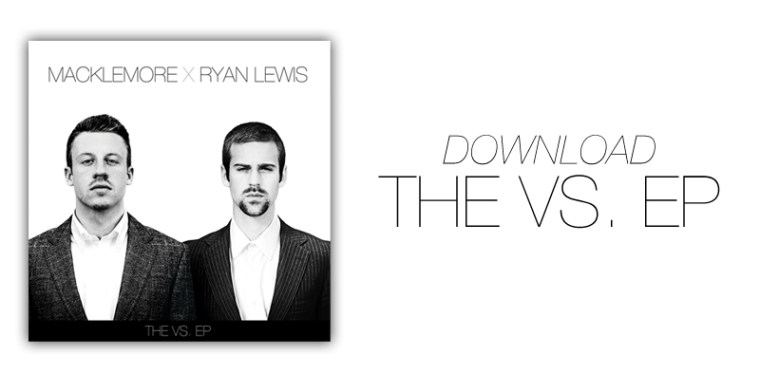
REVIEW: The VS. EP (Macklemore & Ryan Lewis)

The VS. EP is available by free download. Click below for the link.

Macklemore makes music that’s nice to the ears and soul. He is at once confident, humorous, nostalgic, self-deprecating, and completely unapologetic for who he is. For these reasons, he’s one of Seattle hip-hop’s biggest nerds and one of its coolest cats. He’s the rapper other wannabe rapper nerds strive to be like. That is, if said nerds all had the gift of hip-hop gab like him which, alas, they don’t. They’ll just have to go on envying.

On his 2005 debut, The Language of My World, Macklemore showed he could bridge the gap between a white middle-class upbringing and hip-hop, without disrespecting the music’s origins. He found some quick success when he was “discovered” by Myspace co-founder Tom Anderson, and was a featured music artist on the seminal social networking site. It’s easy to accept Macklemore, a white man in a traditionally black and latino man’s game, because of the commitment he shows to the art form. Fair or unfair, white rappers typically have to work harder to be taken seriously, especially in mainstream hip-hop. The fact that Macklemore was willing to recognize and explore the implications of his race in a song like “White Privilege” showed a unique engagement and unspoken pledge to honor hip-hop’s racial history. It doesn’t hurt that Mack has found success as a performer in lily-white Seattle, a city that is eager to embrace hip-hop’s defiant tendencies especially if they’re delivered by someone who appears “safe”. This isn’t meant to criticize Macklemore (that would be faulty and completely unfair), it’s just an unfortunate condition of the racial atmosphere in Seattle. We are not as progressive as we would like to believe. But this is primarily an album review, not social commentary, so let’s get back on track…

The VS. EP marks Macklemore’s second proper album release. (He dropped The Unplanned Mixtape a few months ago as a primer to this.) The Language of My World was solid, sensible, underground hip-hop, and The Unplanned Mixtape continued in that vein, save for a few wacky excursions into comedic territory. VS, however, is a concept album of sorts, at least when it comes to its sonic arrangements. All production is handled by the talented jack-of-all-multimedia-trades, Ryan Lewis. Together, the duo made a conscious decision to dabble in dreaded rap-rock hybrid territory, a particular sub-genre littered with the carcasses of haphazard mash-ups and dubious commercial experiments. I’m happy to report, however, that while others have tried in vain to bridge the rap-rock gap, Mack and RL have created seven tracks of successful coalescence. VS doesn’t sound like something released in haste. It seems to have been well plotted from the start.

Lewis takes samples from well-known rock groups and combines them with hip-hop and electro dance beats, bass lines, and ornamentation. What Lewis attempts has been done before, but rarely with such good results. The lifted samples are blatant, but RL never lets the source material transcend the soul of the album which remains rooted in hip-hop. This isn’t a mash-up, it’s rap music comfortably co-existing with rock flourishes. For example, “Otherside” features an obvious lift from the Red Hot Chili Peppers song of the same name, an instantly recognizable guitar lick that, in the wrong producer’s hands, could have doomed the song. Lewis lets the melody complement the beat, however, and things stay cool. Likewise for “Life is Cinema”, where the defining vocal refrain (“I’ve got soul/But I’m not a soldier”) from The Killers’ Hot Fuss is used as a triumphant rallying cry for overcoming one’s deadly vices (in this case, Macklemore’s former substance abuse problems). And “Vipassana” employes The Moments’ “Love on a Two-Way Street” to a decidedly greater understated emotional effect than compared to the sample’s use in “Empire State of Mind”. Fittingly, the EP’s best tracks represent opposite ends of the experimental spectrum: “Crew Cuts” is a nostalgia-laced Seattle hard-rock posse cut, something that would sound at home on Damon Dash’s BlakRoc. And “Kings” (featuring Champagne Champagne) is an arena-sized Gladiatorial headbanger, with Thomas Gray emerging the victorious emcee.

All of the music works because of Mack and RL’s total commitment to the idea, which is really the greatest thing about Macklemore the rapper. He unabashedly embraces his creative instincts to the point where whatever he tries is sure to succeed. A song like “Irish Celebration” (a tribute to the rapper’s heritage) had the potential to be fairly corny and uninteresting to non-Irish folks, but with Mack’s passion and commitment behind it, it turns endearing. Macklemore is a capable battle-rapper and evocative storyteller, but on VS he’s mostly focused on introspection and confession. He describes his trials with substance abuse and the struggle to get sober in a near whisper that sometimes feels so intimate it’s uncomfortable to listen to on headphones. The song “Otherside”, a cautionary tale about syrup, feels like music as therapy. Anyone who’s ever tried to express a deeply personal part of their lives in artwork knows that that elucidation isn’t easy. It’s important to recognize Macklemore’s rhymes on VS for what they are: a brave and necessary release of the man’s inner demons.

I suppose one could say that Macklemore could single-handedly underwrite emo-rap in Seattle. That’s an unfair assessment of the man’s place in the game, however. To err is to be human, and to create a hip-hop confession of one’s transgressions doesn’t make you the official poster boy for emo-rap. (I hate that term, by the way.) Rapping about what you know is what “keeping it real” is all about. Lots of pretenders exist in the hip-hop game. Macklemore is not one of them.

Album Reviews Downloads

REVIEW: Graymaker (Grayskul)

(Note: This review also appears on national hip-hop blog abovegroundmagazine.com.)

Grayskul are the Northwest’s proudest bastions of hip-hop non-conformity. Unlike many other left-of-center groups that constantly remind listeners of their otherworldly origins, Grayskul’s genesis is rooted more firmly in earth’s terra firma. They’re too human to be aliens, too lively to be zombies. Think of them as creatures more highly-evolved than their fellow rap brethren. Emcees JFK and Onry Ozzborn have mic cords for tendons and kick-drum rhythms for heartbeats. It’s as if they crawled from hip-hop’s primordial ooze in a slightly more advanced state than other humans. A freaky genetic mutation of the hip-hop gene have allowed them to represent a true artistic advancement in the genre.

The last two Grayskul albums (Deadlivers and Bloody Radio) were so consistently excellent it’s hard to put their newest release, Graymaker, into proper context. Listened to end-to-end, the three albums blend together into an extended experience rather than separate distinct collections. Deadlivers remains their most fully-realized conceptual achievement, a sprawling descent into hip-hop madness and the dawning of the emcees’ dark superhero antics. On Bloody Radio, the group returns to daylight, a little less abstraction on their minds and on a mission to rid hip-hop’s landscape of its perceived wackness. And now, on Graymaker, the duo flashes signs of even more normalcy (though I use the term loosely), with what amounts to probably their most consistent and well-rounded album to date.

All of the production on this go-round is handled by Maker (hence the album’s title), a Chicago-based producer whose dark, moody soundscapes immediately reflect the cold, stony winter weather and Gothic architecture of his native Chi. Not surprisingly, the music matches Grayskul’s rhyme aesthetic perfectly. It’s a match made in hip-hop heaven (or hell, as the case may be). “Mars Voltage” takes a crazy horn lick and makes sense of it amidst an ominous bassline and live-sounding drums. “Bread And Wine” hypnotizes with hazy, layered vocals, lackadaisical guitar plucks, and a soul-sample turned eerie. “Bloodwork” is an addictive head-nodder, but in an atypical RZA-esque fashion. The most interesting track is “Machine,” which sounds like the organized ambient noise from an assembly-line plant. It churns and spits and goes in different directions, but never loses focus, much like the entire album. Maker’s production is perfectly anomalous, never veering into total weirdness, yet never boring.

Best of all, Maker lets JFK and Onry do them. One of Grayskul’s defining characteristics has always been the two rappers’ drastically contrasted styles — a This Is So Crazy It Just Might Work-type experiment in hip-hop chemistry. JFK’s controlled rants make him seem perpetually on the verge of a vocal meltdown, whereas Onry’s delivery is so understated that when he says some crazy sh*t, the listener begins to nod and understand that the rapper just might be so crazy. The standard Grayskul fare is here on Graymaker: vocal abstractions spit at rapid-fire pace so as to sound like the blustery ravings of lunatics (“Crazy Talk”), and sh*t talk elevated to such an extraordinarily advanced degree that other rappers might as well not even try to respond (“In the Know”).

The secret of JFK and Onry is that they are experts at narrating the horrors of this world with a poets’ trenchant. What sounds like free-associative wordplay, might actually be social commentary. What sounds like outright dismissal of religion and positive acknowledgment of the occult, might actually be a suggestion to find commonality in our ideas about who God is. The challenge for us listeners is to transcend our tendency to indulge our ADHD (which a lot of hip-hop encourages) to the point where we can recognize Grayskul’s sly wit. When that happens, you can see those sneaking rays of optimism that shine through the group’s pessimistic cloud. Listen closely and you might understand that the joke is on all of us. Souls so dark couldn’t possibly be responsible for hip-hop with this much life.

Album Reviews