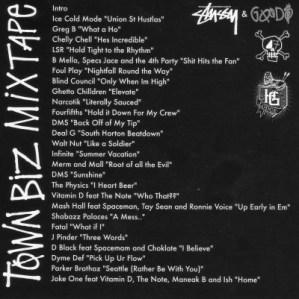
DOWNLOAD: “Town Biz Mixtape” (Compiled by Jake One)

Essential Seattle hip-hop, compiled by The Town’s essential producer, Jake One. The only thing missing is a Kevin Colabro “Good golly Miss Molly!” Click below for the download link, courtesy Puget Soundz blog.

Click above to download at Puget Soundz.

Downloads

DOWNLOAD: “Suite Sixteen” (2009 Red Bull Big Tune Finalists)

I wouldn’t personally know, because I’ve never messed with producing beats as a profession, but I can imagine being a young dude with aspirations of becoming the next DJ Premier, Just Blaze, or Jake One requires many late hours in the lab and a whole lot of hustle.

The 2009 edition of the Red Bull Big Tune featured sixteen finalists with such virtues, including two local cats, KD Cutz and Marcus D, who fully represented The Town at the Finals in Atlanta.

For the first time ever, all sixteen finalists have come together to drop a compilation album, Suite Sixteen, featuring one track from each competitor. This is a great look for these new jacks and a shining example of how much talent remains relatively undiscovered. Cop it for FREE here, or click on the album cover below.

Downloads

REVIEW: “Code Red EP” (J. Pinder)

The Code Red EP is available for FREE download. Click here or the album covers below for the link.

The Code Red EP should probably be considered J. Pinder’s first official entry into the local rap game. The previously released Backpack Wax Mixtape served to introduce folks to the South End rhymer, and it was an unarguably excellent collection of scatter-shot beats and bars. Ultimately, however, it was exactly what it says it was: a mixtape; and thus lacked a coherence that effectively established J. Pinder’s particular identity. The Code Red EP achieves this with a self-assured nonchalance perfectly befitting this emcee.

The first thing you’ll notice is the production and guest shot lineups. Code Red is full of heavy-hitters like Jake One, Vitamin D, and Kuddie Fresh on beats, and established rappers Big Pooh and Guilty Simpson on feature bars. Because of the serious industry weight behind this brief eight-track collection, it sparkles with a certain professionally-applied sheen that we haven’t seen the likes of on any 2010 local releases.

This isn’t to say Code Red is all style and no substance. Quite the contrary. J. Pinder’s subject matter is categorically street-oriented, but ultimately trends toward that most complex of emotions dealt with by people from all walks of life: l-o-v-e. This album is really all about love. Love for your community, love for hip-hop music, love of self, love for your chick, love for your family, etc. There’s even a song about how dangerous and frightening it is to say, “I love you” (“Three Words”). A lack of love is generally the fundamental cause of society’s woes and J. Pinder understands that condition. Code Red is remarkable because the message is delivered in a grown-ass way, never preachy or holier-than-thou, just through observation and down-to-earth real talk.

If there is one knock on J. Pinder, it might be his rhyme style. While he has a knack for never wasting a word, the dude is so unassuming in his flow that he veers dangerously close to sounding indifferent. Not surprisingly, the best tracks on the album are those where he increases emotional effusion. “No Turnin Back” is a track so heavy and thick, it sounds like Vitamin D built it with bricks, concrete and asphalt. It’s about the dangers of losing positive focus when surrounded by so much negativity and J. Pinder gives a great vocal performance. A couple listens are required to appreciate how subtly he shifts from his normal casual breeziness to sounding downright icy. That he’s capable of carrying a track with so much audible weight is a great sign for his future.

Free EP’s are often crafted with the intention of building momentum for a full-length album. Occasionally they also succeed in standing alone on their own merits, as fully-realized collections of songs representing a concept or a brief statement of the artist’s general philosophy. Code Red is similar to The Physics’ 2009 High Society, two extended players that achieved multiple artistic objectives with relative ease. J. Pinder has deftly built an album good enough to capture listeners’ ears today and convincing enough that he’s worthy of following tomorrow.

Album Reviews Downloads

REVIEW: The Stimulus Package (Freeway & Jake One)

(Note: This review also appears on the national online hip-hop site Above Ground Magazine.)

For better or worse, Freeway possess one of the most recognizable and unique voices in hip-hop. As a result, he’s a bit of an acquired taste. Jake One the producer, on the other hand, is a 21st century version of DJ Premier. He uses appropriately melodic soul samples, dusty beats, and well-placed scratches to create a reliable and familiar dose of straight-forward hip-hop.

So while it’s possible the listener might have a more rewarding experience if Jake’s beats were blessed by a more, how-would-you-say, “accessible” emcee than Philly Freezer, it doesn’t change the fact that with their combined powers the two have crafted the best hip-hop album of 2010, thus far.

On one hand, it’s not out of bounds to say Freeway is generally under-appreciated as a rapper. On the other, you can say he’s gotten his just due. Point of reference is important here, too. From a philosophical standpoint, he’s one of those dudes that sort-of bridges the gap between backpackers and radio. Generally known and respected by true heads, Freeway is still only peripherally known by Clear Channel-ers, which is fine. Being a made hip-hop man (of which he is one), does not depend on your ability to please fans of both Brother Ali and Gucci Mane.

It does, however, depend on being reliable and consistent and Freeway has played his hand in the hip-hop game well. Decidedly street, his ability to be both an ambivalent and empathetic witness to the ethical dilemmas faced by fellow hustlers is one of his greatest strengths. On “The Product”, he paints a bleak picture of the role narcotics play in many aspects of American life, neither celebrating the drug lifestyle nor outright dismissing it as something altogether heinous. After all, if it’s a means to put food on the table when all else has failed, what can you ultimately say? Freeway admittedly keeps “One Foot In” the rap game and one foot in the street. This delicate balancing act allows him to maintain a level of authenticity that other rappers have lost.

Jake One, the other half of The Stimulus Package, has become a figurehead in Seattle hip-hop. He probably has the most national influence of any member of the local rap community but his voice is never actually heard. Jake speaks clearly and authoritatively through his beats. He’s an expert at taking a delicate soul sample and layering it over a well-crafted drum pattern such that the essence of the original music partially dissolves and reforms into something entirely new and exciting. His production is rarely flashy or ground-breaking — it’s just solid and consistent.

Jake is in high industry demand these days, and one of the reasons might be because his sound doesn’t seem to belong to any particular coast or region. You can hear obvious Dr. Dre-style Cali influences in the flourishes on tracks like “The Product” and “One Thing”, yet he also shows he can do Dirty South capably too on “Follow My Moves” and “Sho’ Nuff”. Jake One is a true student of hip-hop production; any rapper would be lucky to have him bless an entire album with his beats.

It’s refreshing to see a prominent hip-hop release with the ability to pay equal tribute to rapper and producer as Rhymesayers has done with The Stimulus Package. One DJ and one emcee was once the established symbiosis in hip-hop, but that has gone by the wayside for the most part. The schizophrenia caused by multiple rapper-producer collaborations has much to do with the inconsistent level of quality that plagues most albums. If more well-known rappers like Freeway would stick to the one DJ/one emcee ethic (the way our humble Town so frequently does), we’d see more LPs match the level of quality of The Stimulus Package.

Album Reviews

VIDEO: “She Makes Me Feel Alright (Live)” (Freeway & Jake One)

I did my Town wrong by not making it out to Highline Ballroom last week for Freeway and Jake One’s The Stimulus Package album release party.

Other than Beanie Sigel launching a last-ditch attempt at saving his floundering career, everything looked lovely. Brother Ali showed up to rock the mic with Philly Freezer (on “The Truth”) and Jake Uno rocked his U-Dub hat faithfully.

I love the way Jake cuts up the sample on this track. He’s one of the best working today, period.

(Shout to Blogs is Watching for posting this up.)

Video

Seatown Freezer

On 2.16.10 at the Highline Ballroom in Manhattan, Freeway and Jake One are having their (New York) Stimulus Package album release party. Sometimes living in NY has its benefits — okay, living in NY always has its benefits, but it’s especially great when a collabo like this goes down.

Free, for all his talent and quality discography, always seems just this shy of blowing. I think he’s been underrated his entire career. He’s the quintessential mainstream backpack rapper. I dig his sh*t, and always have.

And what can you say about local boy Jake One other than he’s the most well-known unknown producer in the game, and (I contend) one of the most versatile producers working today.

If you’re in NY on Feb. 16 hit up the Highline. I’ll definitely be there.

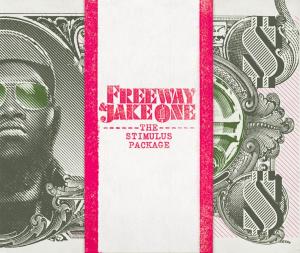
(The album packaging is f*ckin’ filthy, don’t you think?)

Live Coverage

Learn Your History (I Am)

My earliest memories of hip-hop in the 206 begin with Sir-Mix-A-Lot and Kid Sensation. It’s sad, I know, but I’m an 80’s Baby who grew up in the San Juan Islands, a place that, when you’re young, seems light years away from the foreign metropolis that is Seattle, Washington.

Back then, my Seattle points-of-reference were limited to Mariners games, Red Robin and movie theaters, three things I was severely deprived of in my formative years. Hip-hop music and culture was available to me, but only in its mass-market form. I wasn’t close enough to the city to touch the underground. If I had been, I’d probably be a more learned student of the earliest Town movements.

Thankfully we have the internet, where the history of anything is available to those willing to spend time looking. Here are two pieces of Seattle-area hip-hop lore, some brick and mortar carved right from the foundation.

Cocaine Blunts Interview with Jake One and Mike Clark

Click on the photo above for an interview with Jake One and Mike Clark (former host of Rap Attack on KCMU) courtesy of Cocaine Blunts. (Thanks to Andrew Matson, aka The Bulletproof Critic, for Tweeting this yesterday!)

UPDATE (9.24.09): And here’s part two of the interview.

1250 KFOX Facebook Page1250 KFOX was one of the earliest outlets for hip-hop music in Seattle. Click the logo above to open up the time capsule (you gotta have a Facebook account to view). Make sure to check out the very first link, “Emerald Street Boys Nasty Nes Intro” and peep the comments — hip-hop is a family affair for some artists.

Respect the foundation!

Interviews Views From the Peanut Gallery

REVIEW: Ali’Yah (D. Black)

Ali'Yah (D.Black)

The personal and musical metamorphosis of D. Black is a revelation around the 206 these days. In the span of time between the rapper’s debut album, The Cause and Effect, and his latest LP, Ali’Yah, a transformation seems to have taken place in the young man’s heart, mind, and soul which has much to do with assuming new grown-up responsibilities (marriage and the birth of a child) and, as Black has made very clear in recent interviews, a spiritual awakening that’s granted him new perspectives and motivations on why he does what he does.

Regardless of what you believe personally, the overarching force that gives Ali’Yah its potency is the same rare phenomenon that provides all great music their particular validations: honesty. On his new record, D. Black believes firmly in what he’s doing, which is making music for his children, family, and community without fear of contributing negatively to the advancement of those loved ones. He wants to make responsible music for the betterment of his people. In this sense then, Ali’Yah is a soaring achievement.

The seeds for this revolution were planted in The Cause and Effect which, for all its boastfulness, negativity, and hurt, still contained glimmers of both optimism and recognition of why the old D. Black was full of so much anger. That album’s best tracks were, by far, the introspective ones (“This is Why”, “Survive”) which seem to have paved the way for Ali’Yah, a record that can literally be played anywhere. I would feel equally comfortable bumping this album in my car, around small children, or even in church.

Positivity is the rule of the day here. There is no cursing. All the references to bullets flying are accompanied by a call to those responsible to put their burners down. Tales of graphic street violence are omitted and, in their absence, Black has put-forth challenges to the community to better itself (“Keep On Going”). Spiritual growth is also a major theme throughout Ali’Yah and, while not overtly preachy, Black isn’t ashamed to show reverence for the most high on “Close to Yah” (featuring Sportn’ Life labelmate, Fatal Lucciauno).

And, while Black doesn’t shy away from braggadocio, here it’s accomplished more humbly, less as a way to inflict gratuitous verbal beatdowns on wack-ass rappers (which, incidentally, isn’t necessary — it’s obvious D. Black is one of the best emcees in Seattle) and more as a way to progress his positive message. “The Return” is an edict that serves to announce his grand re-entrance to the game while simultaneously calling-out those fake studio gangsters that poison the art form and culture of hip-hop.

Musically, there isn’t one track that stands head and shoulders above the rest, which is actually okay. Albums that endure over time often stand on their conceptual completeness, a trait that Ali’Yah possesses. You probably won’t see a hit single come off this album but there is a satisfying cohesiveness that’s absent on most hip-hop records. Overall, the production is soulful, with a lot of sung hooks (local favorite Choklate blesses a track), but not at the expense of traditional boom-bap, which is to be expected from the likes of Jake One and Vitamin D who handle most of the arrangements.

It’s probably unfair to compare The Cause and Effect to Ali’Yah because they’re such starkly different albums, but the association is unavoidable. While The Cause contained all the traditional elements of aggressive, street-oriented rap, a secondary listen today — in light of what Black has accomplished on Ali’Yah — reveals a tired sound, an almost lethargic Black compared to the new version who is so obviously energized and excited about a new direction.

Perhaps the greatest accomplishment of Ali’Yah is that the rapper, even though he has so blatantly eliminated the guns, drugs, and women (aka, the “realness”), has not lost his credibility. In fact, he seems to have gained more of it. The word “ali’yah” means “ascent” in Hebrew. Here, D. Black has ascended beyond what other rappers have not, surpassed expectations built by his first album, and become a torch-bearer for what hip-hop music is truly capable of.

Album Reviews