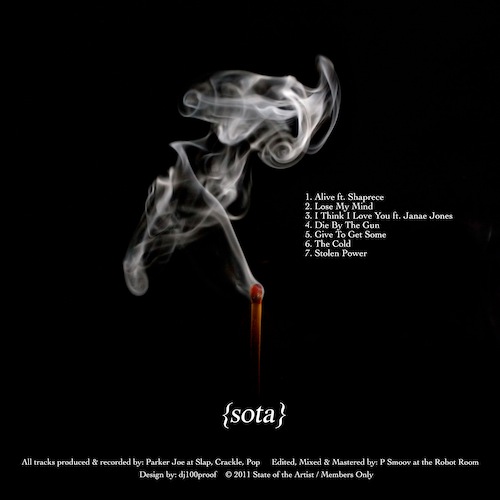
State Of The Artist dropped their new FREE EP today, Altered State. It’s a seven-track collection of anthemic electro-infused hip-hop. The title of the EP is appropriate as the album represents a shift in sound, away from the easy-going party rap of their debut LP, SeaCal, toward a moodier synth-heavy club aesthetic.
With all in-house production by group member Parker Joe, Altered State mostly rejects hip-hop’s traditional norms, so from that standpoint it doesn’t please the way SeaCal did. You can’t knock a group for growing, however, and there is plenty new to appreciate on AS.
SOTA will be heading out on tour with Mad Rad. Check the flyer below for your town:
Mad Rad has evolved into Seattle’s most disruptive force in live music. Ask anyone who has worked security at the six Capitol Hill clubs from which the crew was temporarily banned in January of last year–or local multimedia authority Chase Jarvis, whose dinner spread the foursome nearly ruined during its performance turn at his Songs for Eating and Drinking event. At some point in the last two years, every major music venue in the city has been knocked on its ear as a result of Mad Rad’s antics, welcomed or not. The group has evolved into the easiest band to love or hate, depending on your tolerance level for the asinine. On its way to becoming King of Disruption, Mad Rad has also burgeoned a local following that borders on the rabid and created some of the most dynamic pop music Seattle has ever seen.
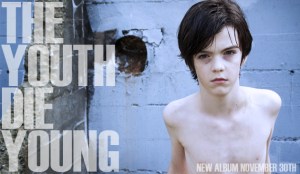
The original version of “The Youth Die Young” (the title track from Mad Rad’s forthcoming album of the same name, streaming, here) is a whimsical but not totally innocent paean to the joys of youth. It’s a celebratory but dubious anthem for the internet generation. There’s a cautionary tale lurking somewhere in the track that belies its upbeat vibe, as if describing a slightly aged Ferris Bueller who’s come to the sudden and harsh realization that the world doesn’t revolve around him. “The Youth Die Young” is actually quite a mature song for Mad Rad, perhaps a sign that the crew is evolving beyond its sophomoric antics of past days. Whatever. The most important aspect of the song is that it gets your ass to moving.
In previous posts I’ve championed Khingz and his music because of the overarching sentimentality that drives it. Whether it’s an unabashed embrace of his sci-fi nerd tendencies, fastidious examination of his race, or total lack of fear over expressing the fact that he’s in love (be it with the woman of his dreams, or a fraternal love with his homies — minus the bullsh*t “no homo”/”pause” bigotry that poisons the hip-hop lexicon). Honesty in music breeds quality product. This has been the consistent ethic throughout Khingz’s career, and to his credit he’s achieved it without ever coming off as self-righteous. He’s walking a tightrope over mainstream hip-hop with his self-respect, principles, and integrity balanced on his back; and he seems to be doing it with ease.
Khingz is also having the most prolific year, musically, he’s ever had. From Slaveships to Spaceships jumped out of hyperspace in the first half of the year to a hungry Seattle hip-hop scene that I personally don’t think was ready for an album of such heavy-handedness. Folks around The Six were too busy taking their clothes off at Mad Rad and Fresh Espresso concerts, acts that feed the debaucheric tendencies of Seattle’s most over-caffeinated scenesters. Not saying there isn’t a time and place for that, but in a town that prides itself on being “conscious” and “progressive,” you’d hope an album like Slaveships would be gobbled up by those same scenesters who are, by-day, members of the supposed coffee-shop intelligentsia. Endless ruminations followed by due shine in the local press would hopefully have followed. In the Weekly’s Best of Seattle Reader’s Poll, Khingz was named “Best MC,” which is certainly a strong statement considering how saturated the local hip-hop market is, but simply being dubbed “one of Seattle’s wittier wordsmiths” in the brief write-up didn’t exactly speak to the complexities of Khingz’s album. No matter. If hip-hop culture trends toward justice (and I believe it does), From S to S will endure the test of time and ultimately be realized as a local hip-hop classic.
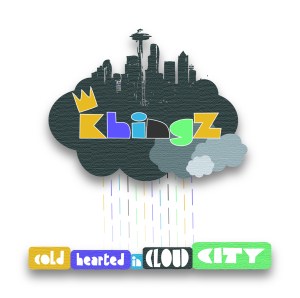
Now enter the follow-up to From Slaveships to Spaceships, Cold Hearted in Cloud City. While not as fully realized conceptually as From S to S (a Star Wars/Khingz-as-the-Blaq-Han-Solo theme loosely holds the sci-fi element together), this record may represent more of a transition in musical styles for the emcee. Gone is the frantic urgency of previous beats, and taking that place is a far mellower vibe. It is, dare I say, more sonically “accessible.” The fact that his rhyme style still meshes well with the more delicate production, only confirms my argument that Khingz is one of the most versatile emcees currently active in Seattle. (Though to be fully accurate, I should qualify that statement by acknowledging he’s since relocated to Vancouver, BC.)
The shift in musical styles is also accompanied by a slight shift in subject matter. Gone is the powerful declaration of liberation, which Khingz presumably nurtured to fruition on Slaveships. Cold Hearted finds Khingz getting more comfortable with his current place in the rap game. He shows he can body wack rappers with ease on “Carbonite Flow;” he confidently declares his journey through hip-hop has been unlike any other on “Kessel Run;” and shows he will gladly rock a party if motherf*ckas just wanna dance on “Devilish Grin.” It’s all done with an undercurrent of trepidation, however, which never allows levity to fully embrace the record. Khingz knows there’s a poison goin’ on (in the world and the rap game; see: “Hybernation Siccness”), and he’s too much of an introspective soul to allow himself to forget it, even for a moment.
On his blog, Khingz says he’s still searching for his “true” sound. It seems Cold Hearted is a brief stopover on that trip. My impression of his last two albums is that he’s found his proper voice, but perhaps his creative muse hasn’t shown him/herself yet. Or, could be that Khingz will realize an entire career with various collaborators and never get comfortable with one particular “sound.” That would be okay with this listener. For a genre that so prides itself on progression and “changing the game,” it possesses few artists that actually deliver on those maxims. In Khingz, it seems hip-hop has found someone that can truly, and willingly, carry that banner.
Here’s a post from today by Andrew Matson (music columnist for the Seattle Times), our faithful voice of realness in the too-often watered-down mainstream media (props to Andrew!). I would second everything he said in his blog entry — the Seattle hip-hop scene is blowing up like Saint Helens in 1980!
(Someone needs to sample the corny intro song to this video. We need an official Seattle anthem. You can’t tell me Marcus D couldn’t flip that folk song into a slapper worthy of a beat battle showdown!)
This blog is still in its infancy (I just started it the first week in July). Its creation was borne from a desire to write critically and thoughtfully about hip-hop and I purposely limited its scope strictly to Seattle because the task of keeping a blog that addressed hip-hop across the nation was absolutely daunting to me. (Not to mention virtually impossible for one person working a normal nine-to-five and attempting to maintain any semblance of a life outside the Interwebs — I don’t know how Shake and Meka over at 2DOPEBOYZ do it, but they hold it down admirably!) The point is, I’m quickly realizing that with the local scene blowing up, it’s hard even keeping pace on a website that’s limited to just our town!
Like A-Mats said, it’s not just an overwhelming quantity of music, but quality, too. Not even five years ago was there a movement this firmly-rooted in The Town. In the last two and-a-half years Seattle hip-hop has blown-up like Bret Boone’s biceps in 2001. It’s like an evergreen tree on PEDs, with a strong root system, a sturdy trunk, and new branches sprouting out every which-way.
There’s even an established hierarchy — though always unspoken. The most revered and respected artists know who they are and the fans who pay close attention can identify who’s got the National Juice by the rumored record deals, the national connects, the outsourced distribution, etc., etc.
Right now, though, it’s such a love-fest that no one’s beefin’ (all you gotta do is follow the rappers’ gabbing on Twitter to see that — it’s like a virtual fraternity house on there, for real).
Likewise, nearly everyone’s write-ups in The Stranger and Seattle Weekly are favorable. Critics don’t want to offend anyone. You’ve got local venues taking cues from their investment bankers: “Diversify your hip-hop, yo!” Fresh Espresso is sharing the stage with Dyme Def on one night, while Thee Satisfaction and Fatal Lucciauno share it on another. Like I said in a previous post, everyone is eating at the same table. And (thankfully) we’ve certainly not reached a Tipping Point, where the community starts to fragment itself into cliques. This happens in other cities — granted, in ones that are usually larger than our modest hamlet. Here’s hoping it doesn’t occur in Seattle.
For now, I say we continue to enjoy ourselves. I’m still gonna bump my favorite artists faithfully. And probably offer some unfair (?) criticism of others that I don’t favor. I suppose we should all take a cue from Brainstorm and “rock out with (our) cock(s) out!” as he recommends in “I’m Gone.” (But only figuratively, please. We don’t want this to turn into a Mad Rad concert…)
Before I get into this rant about Mad Rad, I suppose I have to confess that I’ve never actually seen them live, nor do I own their album, nor do I have any idea about their level of respect for hip-hop culture, how they came to be involved in the art form, who they are as people, if I am actually distantly related to one of them, etc.
I just know that whenever I see one of their videos or listen to their music, I can’t help but think they’re a bunch of f*cking tourists. I get the whole white-boy rap sub-genre that exists in the music, and I understand the need for white kids to express their jones for hip-hop and that that expression sometimes manifests itself in the form of a collage (bastardization?) of less-than-awesome styles (Limp Bizkit comes to mind). What doesn’t sit well with me is when I feel like the culture is being exploited at the expense of an artist or group’s personal gain, and this is where my own personal hypocrisies come into play. For example: I hate Fred Durst, but not Kid Rock. I hate Vanilla Ice, but not Eminem. I hate MC Hammer, but not P. Diddy. Who should be performing hip-hop at this stage in its history is a matter of complete conjecture, so who am I to question someone’s right to participate in the culture? I’ll try to explain myself…
Hip-hop, to me, is like your grandfather’s old Chevy. Whenever he lets you drive it, you should treat it with the utmost respect because, ultimately, it is not yours to keep. You shouldn’t eat in your grandpa’s Chevy; you shouldn’t drink in your grandpa’s Chevy; you shouldn’t make out with your girlfriend in your grandpa’s Chevy, unless, of course, you ask him for permission to do so, and he says that it’s okay.
Everything I’ve been told and read suggests that Mad Rad puts on a hell of a show. I understand they really get the crowd hyped, they have actual skills on the mic, and their production is on point (as much as a rap/punk/electronic collage of sound can be “on point”). I also know that they often behave like complete jackasses, getting themselves banned in local clubs, nearly destroying Chase Jarvis’ beautiful spread at his Songs for Eating and Drinking event, and generally causing hundreds of hipsters to lose their skinny-jeaned, coked-up minds in the streets of Capitol Hill.
So why must I hate? Probably for these reasons:
1. I’m not a member of a rap group, and they are. I can love hip-hop as much as anybody, but it doesn’t mean that I’m a particuarly active participant. I’m a consumer of the music, I pay for albums and shows, and I can hop in a car, put a CD on, and rhyme alongside my favorite emcee and think that I sound pretty damn dope (especially when the volume is turned all the way up). But I have never been in the studio, gotten in front of a mic and dropped 16 bars over a Jake One banger. And that will probably never happen. So why do I hate Mad Rad so much? The number one reason might be because I will never get to do what they’re doing.
2. I think hip-hop music ultimately belongs to the African-American community. If hip-hop was patented, it would be owned by the pioneers from the South Bronx. Of course, that would never happen because hip-hop, by its very nature, is a collaborative effort, and many non-African-American folks have come along in the game and done it well. In fact, arguably just as well, if not better than some of the music’s earliest founders. But that doesn’t mean true ownership has ever been transferred. I’m sure there are some pretty amazing Japanese chefs who can prepare Coq a Vin just as well as a French chef, but just because you’re Japanese cooking French, doesn’t mean you don’t have to be qualified.
And are Mad Rad qualified to be doing hip-hop the way they are doing it? Who am I to say? I guess my point is that when I see Mad Rad performing for their fans (who are majority white, hipsterish and presumably not the most learned fans of hip-hop culture), I get upset. Especially when Mad Rad is dropping lines like “smoke the dro/choke a ho.” Not that anyone should be able to get away with saying that and have it be okay, but when it’s coming out of the mouth of a white dude wearing ironic sunglasses and a gold chain? It sounds more like disprespectful parroting than a conscious attempt at what I can only presume is sarcasm.
In the end, I suppose the point of Mad Rad is to bring a different perspective to the genre. They appear to simply be a group of white men expressing their creativity and points of view as honest fans of the music. And, inherently, there is nothing wrong with that.
I guess I just wish they’d been required to attend a sort of Hip-Hop University where they first had to study the origins of the culture and earn a diploma before being able to release their first album. Come to think of it, the curriculum at Hip-Hop University would probably be useful for a whole gang of other hip-hop artists in the game today.
Probably the most important tool in helping propel the art form into the future, is a knowledge of the roots of its past. Mad Rad, in my opinion, haven’t properly traced those roots. They need to go back to Hip-Hop University. They need to ask their grandfather if they can ride in his Chevy.



 Here’s a
  A SEATTLE HIP-HOP BLOG