
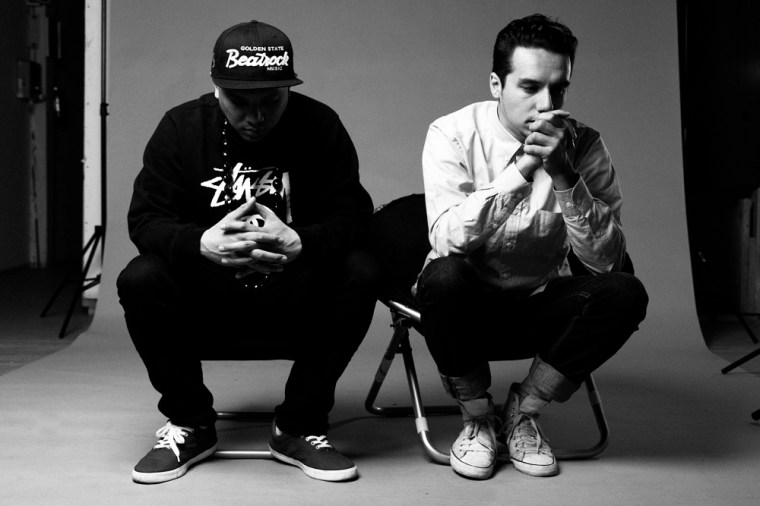
Photo by Canh Solo.
The second week of June was the center of the hometown promotional storm for Blue Scholars. In support of the group’s third LP, Cinemetropolis, Geo and Sabzi did no less than play three shows (two back-to-back album release parties at Neumos and one invitation-only Kickstarter appreciation show), dropped the album’s first music video for the track “Fou Lee,” appeared at an in-store special edition t-shirt signing at Seattle Stüssy, and played an on-air KEXP studio session with DJ Kevin Cole.
The group has remained steadfast in its musical independence, both in sound and from a business standpoint. And though Blue Scholars didn’t have the industry weight or promotional heft of a record label behind them with this album, its release felt no less important to the city of Seattle and its burgeoning hip-hop scene. This crew carries a lot of capital, creative and otherwise. It remains one of the most visible faces of Seattle rap on a national level and, judging from the overwhelming response to its Cinemetropolis Kickstarter campaign, continues to resonate with the entity that matters most: the fans.
I caught up with Geo and Sabzi backstage at Neumos, a few minutes before they played the second of two sold out shows at the venue.

Photo by Dave Lichterman for KEXP.
You guys seem really relaxed, almost in like a Zen state, with the release of Cinemetropolis. Are you guys at a place in your careers where you’re relaxed when putting out new material?
Geo: Yeah, definitely. That’s an interesting observation. I’d say it varies from one project to the next. But when it comes to the full length albums, we wouldn’t [normally] release it unless we were 100% cool with what we had. Not super perfectionist type shit, but just something that we feel represents where we’re at at that given point. We’ve always had the philosophy that we want our music to be a time capsule of where both me and Saba are at individually, at the time of creation of that album. I guess we do kinda exude a Zen approach because so much [tension] gets released by the time the record is presented to the public that we’re just like, “Hey it’s out there, man.”
Sabzi: [That’s] definitely how this record has gone.
Cinemetropolis sounds totally different than anything you’ve done before it. There was no fear of alienating your fan base?
Geo: No, if we did we would never release it. We are very aware of how different this record sounds from the last. If we took even, like, five minutes to sit and think about that and be worried about it, I would go fucking crazy. So maybe it’s like a defense mechanism to be like, “Hey man, whatever happens, happens.” When it comes time to release something, all those moments [of questioning] have already happened. I think what we’re always doing is trying to navigate through both our personal lives and our collective lives and then making sure the music is at the intersection of where we’re at. That’s why there’s a cinema influence. That’s why we didn’t go with a label. All of that is part of the story. If things are fucked up, we want it to be our fault and nobody else’s.
Speaking of navigating your personal lives, how have you dealt with being on opposite coasts? (Geo lives in Seattle and Sabzi has been splitting time between Seattle and New York.)
Sabzi: [The recording] was done here. It’s really not that different. When we first started making music in like 2001, I would make beats, upload it to FTP and Geo would download it.
Geo: We lived a five minute walk away from each other and we still made the first album mostly over the internet.
But New York has a different kind of energy. Sabzi, did you make the beats there or in Seattle? Was there a different type of creative process in the two cities?
Sabzi: I didn’t make them all out there. I made “Fin” in New York. I made “Oskar Barnack ∞ Oscar Grant” there. Half of it was Seattle and half of it was New York. I’d say tracks like “Hussein” and “Fou Lee” were template cuts for making the rest of the record, so we were already heading in that direction. When I moved to New York I didn’t have my record collection with me so that was a concrete factor that influenced the creative process. I didn’t have them to sample from, so every time I sat down to work it was all synth-based. I just don’t really think like that [about the recording environment]. I’m not saying there’s no influence, like I’m somehow above my environment which isn’t true at all, but it’s nothing I’m conscious of. As long as I have the same computer and, like, the distance between my chair and my computer and keyboard, it’s the same. And whatever I experienced that day will feed into it. There’s a lot more dancehall being played [in New York]. People have commented this record has a lot of island rhythms on it.
And what about from a writing standpoint? Does your environment affect how you write rhymes?
Geo: I mean, I’d like to think I have a visceral writing style and so that the experience of traveling and coming home, going out, jogging at Seward Park, riding the subways through Manhattan, I think I’m conscious of that. I’m thinking of rhymes as I’m going. And then you go into the lab to execute those ideas. If I’m on the train I can pull out my phone and record the thought and then that makes it onto the record. So for me, I’d have to say that influence [of being in New York and other locations] is definitely on the record more than any of the other stuff we’ve done before.
I wanted to ask you about two tracks, specifically. The first one is “Hussein.” Is it about Barack Obama?
Geo: It could be. [Laughs]
There’s a line, “What happens when you think patience always means wait,” which resonates because of the shift in optimism from his election in 2008, when so many folks thought it meant instant change for the better, to today when everyone is impatient, still waiting.
Geo: I was one of the people that, on one hand, was very critical of Barack and his message of hope and very idealistic things, knowing that he’s just one dude who’s talking all this good game, knowing that the system is set up so that he can’t change it overnight or even in four years. But then you can’t discount the fact that it is a historical moment for this country, at least symbolically. “Hussein” was the first song completed for the album. It was probably done by early ‘09.
The fact that this country even elected someone with that middle name spoke volumes, symbolically.
Geo: There were a lot of conversations about his middle name, man. It was a lightning rod. A carry-over from anti-Muslim hysteria, anti-Middle Eastern hysteria. In this country that name is so politicized. It evokes a reaction from everyone, whereas you go to other parts of the world and “Hussein” is just another name.
Sabzi: I think it spoke volumes to like, “Yo, this is how we’re gonna fix it. Like, we’re down! All done!” Electing him is not much different than adopting a Korean baby. It’s kinda like, “We’re hella ‘about the world!’”
I’m Korean and adopted. [Laughter]
Sabzi: Oh, for real? Yeah, but your parents aren’t celebrities.
No, they’re not. They’re definitely not celebrities.
Sabzi: You know what I mean though, right?
[Laughter] Yeah.
Geo: That’s exactly what the song is about. One thing that probably triggered the song the most, more than all the political stuff we’re talking about now that people in coffee shops everywhere talk about, is on Facebook that year [2008] people were changing their middle names to “Hussein” and in the “Political Views” people were writing, “Obama.” It’s somewhat of a triumph over Bush and [the] Neo-Conservatism that has dominated America for most of the last decade. It was like, we know who the enemy is and maybe it took that long to realize it. Maybe it’s just gonna take a little longer to realize who the people [are] that are gonna do something about it. For a brief moment people really gambled on the Democratic Party, via one dude, to be that. I think it’s very obvious that the “patience means wait” approach to politics is bankrupt, man.
Sabzi: For the record, I personally am really glad Barack Obama is the President. And I don’t give a shit if he changes anything ‘cause that’s not what he’s supposed to do. The President doesn’t really matter. You might as well just have him be tight. Like, let’s just have a cool-ass dude as the President. That makes a huge difference. If you travel internationally now, they’re like, “Whattup, man? You’re from America? Swag!” And it’s way more about “swag” than anything else. Just to be clear: thumbs up Obama, from me at least.
The other track I wanted to ask you about is “Seijun Suzuki.” I perceived the song to be about the Seattle hip-hop scene — not so much a shot at The Town, but more of a challenge, like: Who’s really trying to “make it?” What’s your general take on what’s going on in the Seattle rap scene right now?
Sabzi: Better than ever before.
Geo: Yeah, it is. It’s interesting you mentioned that. I would say it’s actually more of a statement on rap in general. I’ve developed a reputation of being that dude that every song I write is “about some shit.” I’m a Lil’ Wayne fan, man, as well as a Mos Def fan. So there’s the element that, on one hand, I am tired of “rap about rap” but I’m also a fan of “rap about rap” when it’s done in a manner that moves me. It’s not necessarily about a super-conceptual idea. I was thinking about this while I was watching [Seijun Suzuki’s] films. There’s a lot of criticism about Seijun Suzuki in his day about like, “This dude’s films ain’t about shit.” On the other hand there are people really over-analyzing his films when they were just low-budget Yakuza flicks. I thought that was interesting because they’re both right and they’re both wrong. But at the end of the day it was just the artist doing him. And I think this [track] is where I wanted to put the foot down and be like, “You know what, I don’t wanna rap about anything in particular on this song. We’re gonna pull a Seijun Suzuki up in this ma’fucka, man. I’m gonna touch upon a subject in one bar and then I’m just gonna rap about nonsense.”
But there’s that line, “The day we decided to make it like Jake and Vita,” that specifically references the two, arguably, most well-known industry dudes in the Seattle rap scene.
Geo: I’m glad you caught “Jake and Vita.” A lot of people thought I was saying “Che Guevara.” I threw Jake and Vita in there because, to me, I feel like there’s a perception of what success is and should be, and here are two dudes that have molded a sound and a scene, and a lot of the [artists] that we look up to know these cats. But to a lot of people, if you’re not out in front of the crowd or all up on TV, then you haven’t “made it.” To me, there are people who have “made it” [that aren’t like that]. And that’s connected to the hook, “Ain’t nobody winnin’ everybody’s scared of losin.’” I think there are a lot of people that want it but are afraid to really put themselves out there because they’re afraid who they really are is not gonna translate. So they do really well at emulating what’s out there. And that’s not just a hip-hop thing, that’s a music thing, a film thing, a life thing. We’re in a phase where everybody’s half winning.
You’re going on tour to promote Cinemetropolis soon, right?
Geo: Yes, the details I can give right now are it’s gonna be in September, October and November, give or take 30 dates. It’s our first headlining tour that’s longer than a regional run.
Will there be a New York date? The last show you played, at the Bowery Ballroom last September, felt triumphant not only for you guys but Seattle hip-hop in general.
Geo: Yeah, it was. It’s a moment that I don’t think can ever be captured again. It was crazy because we hadn’t put out a full length album in almost four years. All signs pointed to that show doing moderately well or even failing. Bowery is supposed to be one of the spots. You have to build your way up to it or you have to really be on some super hype shit, and we were neither. Everything fell into place. Half the crowd was from Seattle or had roots in the area. I’m grateful. That was probably one of my top five favorite shows.
Sabzi: I thought it was great. I’ve been to a lot of different events in New York from like Highline [Ballroom] to little parties at CV [an exclusive club on the Lower East Side of Manhattan] and we sold out Bowery and there were no scenesters there. So I think that’s really interesting. There are so many different sides to New York City and one of them is definitely like a town, like ours here. It was like the New York version of the fans that come here, who are real people, with real jobs, who live in the boroughs, who listen to music and good stuff, came through. And I don’t hate scenesters, I actually think they’re really tight ‘cause I am one [laughs]. But I liked how we could sell that [show] out without needing that.
What’s up with the side projects? Geo, you have a new EP, Walk Into A Bar, coming out soon with Bambu.
Geo: It’s nine tracks, ten with the bonus track. Beatrock Music, who puts out Bambu’s stuff, took interest and is actually making it an official Beatrock Music release. [Bambu] is gonna be our main support on the fall tour. This is like our BFF Hawaii record. It’s like OOF two [laughs]. On one of our trips to Hawaii we had planned to do one or two songs with a Hawaii-based producer and give it to In4mation to throw on their blog, and we ended up doing three and did the rest over the internet. A lot of Seattle producers got involved and it became an actual project. It happened all because we literally walked into a bar our first night in Hawaii and decided to do a few songs.
Sabzi, you released a side project, Made In Heights, with singer Kelsey Bulkin last winter. Is there more to come from that collaboration?
Sabzi: We have another collection that’s already recorded. That’s what I’m doing in New York. If everything works out then I’d like to do one or maybe two more things with Made In Heights, perhaps like a full record and get a lot of New York people involved. Really take it in the opposite direction of everything I’ve done before. And then I plan to do plenty of solo stuff. Forever. For the rest of my life!





 A SEATTLE HIP-HOP BLOG