Tone Loc’ed

seattle wingNo one captures the spirit of hip-hop on film quite like Tone. Here’s his latest entry from Seattle, a particularly stunning photo essay featuring some of our favorite artists, local spots, and regular townsfolk doing their thing in our fair city.

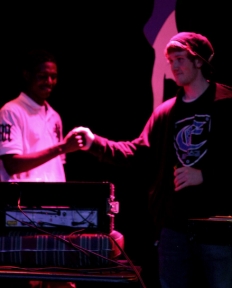
backstageBackstage somewhere. The groupies must be hidden off-camera. Just kidding — Macklemore and GMK are too gentlemanly for that.

Photos

VIDEO: “Lazerbeams” (Fresh Espresso Live on KEXP)

I guess it doesn’t really matter that P Smoov looks like he just stepped out of Seattle, circa 1992, nor that Rik Rude seems to have stolen my grandfather’s Hawaiian shirt. As long as they’re doin’ it for the love of hip-hop, right?

Video

Seattle U.N.I.T.Y. (For Now)

graffitijohnschuhHere’s a post from today by Andrew Matson (music columnist for the Seattle Times), our faithful voice of realness in the too-often watered-down mainstream media (props to Andrew!). I would second everything he said in his blog entry — the Seattle hip-hop scene is blowing up like Saint Helens in 1980!

(Someone needs to sample the corny intro song to this video. We need an official Seattle anthem. You can’t tell me Marcus D couldn’t flip that folk song into a slapper worthy of a beat battle showdown!)

This blog is still in its infancy (I just started it the first week in July). Its creation was borne from a desire to write critically and thoughtfully about hip-hop and I purposely limited its scope strictly to Seattle because the task of keeping a blog that addressed hip-hop across the nation was absolutely daunting to me. (Not to mention virtually impossible for one person working a normal nine-to-five and attempting to maintain any semblance of a life outside the Interwebs — I don’t know how Shake and Meka over at 2DOPEBOYZ do it, but they hold it down admirably!) The point is, I’m quickly realizing that with the local scene blowing up, it’s hard even keeping pace on a website that’s limited to just our town!

Like A-Mats said, it’s not just an overwhelming quantity of music, but quality, too. Not even five years ago was there a movement this firmly-rooted in The Town. In the last two and-a-half years Seattle hip-hop has blown-up like Bret Boone’s biceps in 2001. It’s like an evergreen tree on PEDs, with a strong root system, a sturdy trunk, and new branches sprouting out every which-way.

There’s even an established hierarchy — though always unspoken. The most revered and respected artists know who they are and the fans who pay close attention can identify who’s got the National Juice by the rumored record deals, the national connects, the outsourced distribution, etc., etc.

Right now, though, it’s such a love-fest that no one’s beefin’ (all you gotta do is follow the rappers’ gabbing on Twitter to see that — it’s like a virtual fraternity house on there, for real).

Likewise, nearly everyone’s write-ups in The Stranger and Seattle Weekly are favorable. Critics don’t want to offend anyone. You’ve got local venues taking cues from their investment bankers: “Diversify your hip-hop, yo!” Fresh Espresso is sharing the stage with Dyme Def on one night, while Thee Satisfaction and Fatal Lucciauno share it on another. Like I said in a previous post, everyone is eating at the same table. And (thankfully) we’ve certainly not reached a Tipping Point, where the community starts to fragment itself into cliques. This happens in other cities — granted, in ones that are usually larger than our modest hamlet. Here’s hoping it doesn’t occur in Seattle.

For now, I say we continue to enjoy ourselves. I’m still gonna bump my favorite artists faithfully. And probably offer some unfair (?) criticism of others that I don’t favor. I suppose we should all take a cue from Brainstorm and “rock out with (our) cock(s) out!” as he recommends in “I’m Gone.” (But only figuratively, please. We don’t want this to turn into a Mad Rad concert…)

Views From the Peanut Gallery

Streets On Fire

It was f*cking hot in Seattle last week. To add heat to the already record-breaking temps, Dyme Def set fire to the streets of downtown with this video for “I’m Gone!” Did you see ’em? They were hard to miss!

The guerrilla-style camera work is a good look — and all made with the magic of 3GS iPhones. That’s ballin’ on a budget right there.

Video

Hawaii 808

hawaii_satelliteSome more OOF! EP sh*t from Blue Scholars. (I’ve been posting a lot about BS lately — I swear this is not a fanboy site for them dudes. Their sh*t is continual dope, though, that cannot be denied…)

(UPDATE, 8.5.09, 11.35am: And here’s a story from the Seattle Weekly that gives the best explanation, to date, of the deal struck between Duck Down Records and Caffe Vita.)

(UPDATE, 8.5.09, 5:35pm: And a little video preview of the OOF! EP. I’m diggin’ the marketing campaign, thus far. Thanks, Duck Down!

Breaking News Downloads Views From the Peanut Gallery

Seattle’s Far From Harmonious, But I’m Just Sayin’…

One of the truly remarkable things about our local hip-hop community, is that artists from all walks of life can share the stage together and be heard, understood, and, most importantly, accepted, by an audience of fans that is sometimes just as diverse as they are. The relative smallness of Seattle has a lot to do with that. It’s a place where a short, skinny, white kid from Ballard can rhyme alongside a tall, African-American dude from the South End and both are celebrated just because they sound great on a track together.

It’s not that fans in The Town don’t typify the artists (that’s just a natural reaction to different styles of music), but the community is so small that everyone is allowed to eat at the same table. Because of this, Seattle might be one of the least-marginalized hip-hop communities in the country. In this way, at least, we are truly “progressive.”

I hope Seattle’s inclusive nature helps to dispel the myth (usually held by casual or unlearned fans of the music) that you don’t have to be a gangsta, or surrounded by the gangsta lifestyle, in order to be a legitimate hip-hop artist. White kids can laugh knowingly and rap along to “My Volvo,” and then hopefully pause and listen carefully to a track like “This is Why.” The true power of hip-hop is displayed when it unites us through familiarity in the music, our heads “nodding in agreement” despite our differences that keep us divided. Of course, the music itself doesn’t solve all our problems borne from society’s ills, but at least it opens the door for dialogue. It’s our job as conscious listeners to step through.

All that being said, everyone still knows that the gangsta aesthetic plays a huge role in the lives and careers of many artists. Some just borrow the image to fit their desired style (always to the detriment of the culture), and some artists have lived through it, or are living it for real.

Here are two perspectives from local emcees that have lived it, survived it, and are now imparting their knowledge from their experiences:

khingz

The first is an interview with Khingz from the hip-hop lifestyle blog 12ft Dwende.
Fatal_SoundNW-Cover

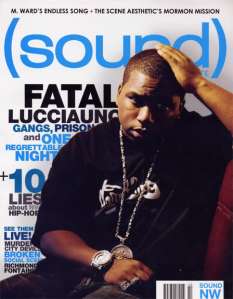
The second is a video interview and performance by Fatal Lucciauno from Sound Magazine.

One final thought:

“Gangsta rap” is a tricky piece of terminology. Mainstream media and the music business have removed virtually all societal value from that style of music, boiling it all down to an easily-marginalized brand of rap that has been happily commodified and put on sale, and yet simultaneously blamed for contributing to negative stereotypes and teenage violence. And, while pundits are not always completely wrong to criticize its shortcomings, gangsta rap has been stripped of its power to inform. Too many artists are quickly qualified as “gangsta rappers” and then summarily dismissed as nothing more.

It’s important to note that neither Khingz nor Fatal Lucciauno are “gangsta rappers” in the commonly-defined sense of the term, but both speak about issues related to that walk of life.


Downloads Interviews Video Views From the Peanut Gallery

Piece at Hidmo

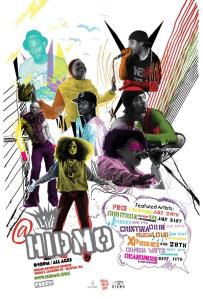
live@hidmoFrom the first iteration of the brand new Live @ Hidmo series, which, as the name suggests, is a weekly live show at Hidmo Eritrean Cuisine (20th and Jackson) featuring local musical acts every Friday from 8 to 10 pm.

Laura “Piece” Kelley and DJ B-Girl kicked things off on 7.24. Here’s how it went down.

It’s free and all ages, so there’s no excuse not to come through!

Live Coverage

REVIEW: From Slaveships to Spaceships (Khingz)

CD400Concept albums are always a tricky business. Rarely do they succeed in achieving a true sense of coherence, a completeness in actualizing the very “concept” they’re attempting to convey. Either they fall short because of straight-up weirdness, or inconsistencies that exist somewhere in the actual music (be it in production, lyrics, style, or what-have-you).

Because concept albums so often fall on their ambitious faces, to simply call Khingz’s second solo entry, From Slaveships to Spaceships, a “concept album” would be doing the record a disservice. It’s actually much more than that. If a music artist’s work is always inspired by something they either find valuable or have experienced in perpetuity throughout their lives, then a coherent expression of that in a single album is much less a “concept” and more a concrete expression of the artist’s reality.

From Slaveships to Spaceships certainly qualifies as an expression of Khingz’s life and experiences as a self-admitted social outcast. It’s only because science-fiction themes are so pervasive throughout that a critic like myself is excused when using the term “concept album” to help describe the record.

The album’s title and sci-fi terminologies aside, FStoS exists more on the terra firma that is Seattle’s South End than it does in the outer-reaches of our galaxy. It’s an honest expression of life as a person of color in The Town’s suddenly en vogue southern neighborhoods. Bitterness, confusion, and self-realization are all explored in dramatic fashion. Khingz (much like his brother Gabriel Teodros) is a sensitive dude. And, also like GT, restraint in his lyrics is not a problem he suffers from. There’s a valuable and uncommon connection between art and self-awareness here that makes for some heavy-handed sh*t, like the emotional tour de force of the title track. By the end of the song Khingz sounds like he’s lived enough trying times for a thousand lives.

Sonically, this album runs the gamut. From hyper-active beats emulating space battles (“Hydroplanin'” made me feel like I was stuck in the middle of a shootout between Stormtroopers and the Rebel Alliance) to the smoothed-out hip-hop valentine “Blaq Han Solo.” There’s an undeniable energy running through these beats; it’s equal parts thoughtful production and Khingz’s own crazy-versatile flow that act as the electrical current bringing each track to life.

Throughout this record, Khingz makes clear that he’s seeking his liberation from something. Could be the past. Could be liberation from the typical musical stylings that so often contribute to the stagnation of his beloved art form. Whatever. As a listener I was just happy that, by album’s end, he seems to have found what he’s looking for. As fans of hip-hop, we should be thankful that Khingz expresses his liberation through his music. It makes for “important” hip-hop in the most well-defined sense of the word.

Album Reviews

“They Say I Come Off a Little Self-Righteous…”

I just pulled this clip off another blog (shout to Blogs is Watching). It’s RA Scion being interviewed by some floppy-haired dude from Seattle’s Sound Magazine. Take a gander (and peep the antique-style throwback lamp in the background, probably purchased for $19.99 at the Fred Meyer Mothership in Ballard):

(Note to Sound Magazine: YOUR EMBED CODES NEVER WORK, YO! Check the video HERE.)

It’s fitting that RA’s on some cable access-type sh*t here, being that he’s perpetually “about the people.” A couple thoughts:

1. Are RA’s opening words a foreshadowing of an official “Due to irreconcilable differences, RA Scion and DJ Sabzi have decided to end their creative relationship” statement? Here’s hoping that doesn’t come to pass any time soon. Still, it was interesting to hear him say he thinks the group has gone as far as it can creatively. Makes me wonder what RA has in mind for his future musical endeavors. (Please don’t say “dance record,” please don’t say “dance record…”) There’s a huge amount of artistic integrity there when he says he doesn’t want to “milk” the group for more than it’s worth; lord knows CM’s musical endeavors haven’t been hugely rewarding from a financial standpoint so that can’t be what he’s referring to.

2. At about the 5:50 mark, RA starts speaking his mind on the supposed “progressive” mind-state of Seattle’s residents. He calls Fremont “the biggest fucking sham of progressive politics that I’ve ever seen in my whole life…a bastion of bullshit.” I like that this statement caused a few uncomfortable chuckles around the room — I really hope some of those folks live in Fremont. I definitely feel RA on this one. A few hippie artists and their naked bike-riding friends a “progressive neighborhood” do not make. All I know is that going out on a Saturday night in Fremont is only fun if you’re a white male between the ages of 23 and 30, six feet or over in height, and wearing a severely creased Abercrombie and Fitch hat (save for those nights at Nectar when Sportn’ Life wrecked sh*t on the regular).

I’ve never met RA, but he seems to possess a very intense personality, which is probably why his lyrics are so often inspired. Say what you will about him, but you certainly can’t question his love for hip-hop, nor his commitment to being honest and true to the art form.

Video Views From the Peanut Gallery