(Note: This review also appears on national hip-hop blog abovegroundmagazine.com.)
In previous posts I’ve championed Khingz and his music because of the overarching sentimentality that drives it. Whether it’s an unabashed embrace of his sci-fi nerd tendencies, fastidious examination of his race, or total lack of fear over expressing the fact that he’s in love (be it with the woman of his dreams, or a fraternal love with his homies — minus the bullsh*t “no homo”/”pause” bigotry that poisons the hip-hop lexicon). Honesty in music breeds quality product. This has been the consistent ethic throughout Khingz’s career, and to his credit he’s achieved it without ever coming off as self-righteous. He’s walking a tightrope over mainstream hip-hop with his self-respect, principles, and integrity balanced on his back; and he seems to be doing it with ease.
Khingz is also having the most prolific year, musically, he’s ever had. From Slaveships to Spaceships jumped out of hyperspace in the first half of the year to a hungry Seattle hip-hop scene that I personally don’t think was ready for an album of such heavy-handedness. Folks around The Six were too busy taking their clothes off at Mad Rad and Fresh Espresso concerts, acts that feed the debaucheric tendencies of Seattle’s most over-caffeinated scenesters. Not saying there isn’t a time and place for that, but in a town that prides itself on being “conscious” and “progressive,” you’d hope an album like Slaveships would be gobbled up by those same scenesters who are, by-day, members of the supposed coffee-shop intelligentsia. Endless ruminations followed by due shine in the local press would hopefully have followed. In the Weekly’s Best of Seattle Reader’s Poll, Khingz was named “Best MC,” which is certainly a strong statement considering how saturated the local hip-hop market is, but simply being dubbed “one of Seattle’s wittier wordsmiths” in the brief write-up didn’t exactly speak to the complexities of Khingz’s album. No matter. If hip-hop culture trends toward justice (and I believe it does), From S to S will endure the test of time and ultimately be realized as a local hip-hop classic.
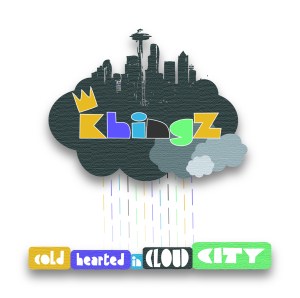
Now enter the follow-up to From Slaveships to Spaceships, Cold Hearted in Cloud City. While not as fully realized conceptually as From S to S (a Star Wars/Khingz-as-the-Blaq-Han-Solo theme loosely holds the sci-fi element together), this record may represent more of a transition in musical styles for the emcee. Gone is the frantic urgency of previous beats, and taking that place is a far mellower vibe. It is, dare I say, more sonically “accessible.” The fact that his rhyme style still meshes well with the more delicate production, only confirms my argument that Khingz is one of the most versatile emcees currently active in Seattle. (Though to be fully accurate, I should qualify that statement by acknowledging he’s since relocated to Vancouver, BC.)
The shift in musical styles is also accompanied by a slight shift in subject matter. Gone is the powerful declaration of liberation, which Khingz presumably nurtured to fruition on Slaveships. Cold Hearted finds Khingz getting more comfortable with his current place in the rap game. He shows he can body wack rappers with ease on “Carbonite Flow;” he confidently declares his journey through hip-hop has been unlike any other on “Kessel Run;” and shows he will gladly rock a party if motherf*ckas just wanna dance on “Devilish Grin.” It’s all done with an undercurrent of trepidation, however, which never allows levity to fully embrace the record. Khingz knows there’s a poison goin’ on (in the world and the rap game; see: “Hybernation Siccness”), and he’s too much of an introspective soul to allow himself to forget it, even for a moment.
On his blog, Khingz says he’s still searching for his “true” sound. It seems Cold Hearted is a brief stopover on that trip. My impression of his last two albums is that he’s found his proper voice, but perhaps his creative muse hasn’t shown him/herself yet. Or, could be that Khingz will realize an entire career with various collaborators and never get comfortable with one particular “sound.” That would be okay with this listener. For a genre that so prides itself on progression and “changing the game,” it possesses few artists that actually deliver on those maxims. In Khingz, it seems hip-hop has found someone that can truly, and willingly, carry that banner.



 A SEATTLE HIP-HOP BLOG